Loading...

Access Hound — Writings From the Field

Accessible Media is Better, More-Inclusive Media

Posts in "Accessibility"

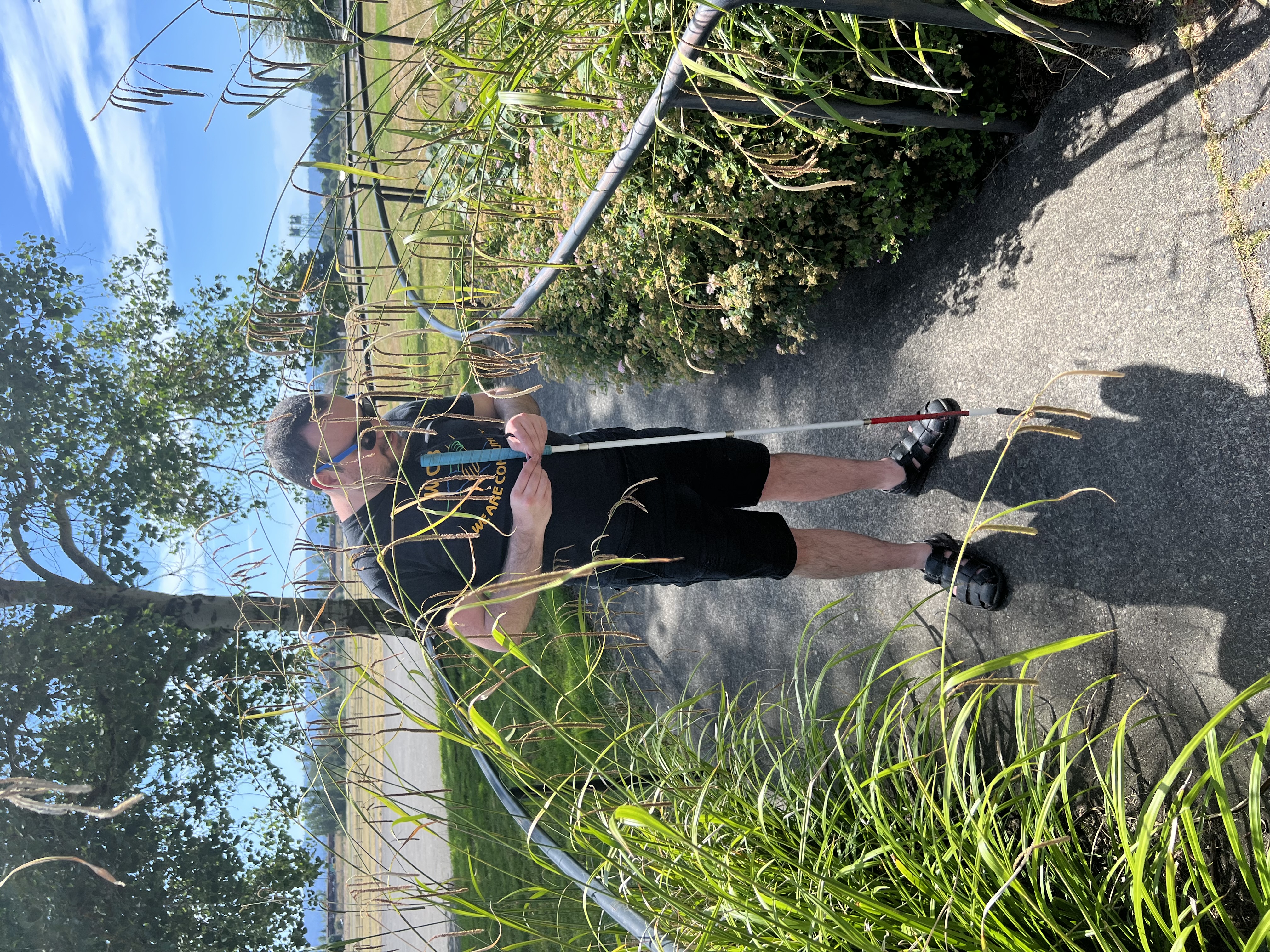
An Access Hound collaborator who is blind is stopped cold by overgrown vegetation on an entry ramp at a public place.

DESCRIBING: A vertical color photograph.
SYNOPSIS: A man with a white cane stands on a sunlit sidewalk, which is bordered by railings and thick vegetation that crosses over the railings, blocking the path. Long grass stems droop across the walkway at face height. The person faces downward and pauses, trying to decide how to approach the obstacle. 

IN-DEPTH DESCRIPTION: The photo centers on a white man with short dark hair, sunglasses, a black T-shirt, black shorts, and black sandals. He is facing the camera, in the center of a narrow and smooth concrete path that curves gently into the distance to the viewerʻs right and is lined on both sides by a waist-high metal handrail. The person holds a white cane in both hands; the cane tip points to the pavement near his right foot. Long, seed-tipped grasses arch from both sides of the path and brush the person’s head and chest, creating a face-level barrier. A midday sun casts a shadow of the person and cane onto the path in front of him.

Photo by Brett Oppegaard

Accessibility

Accessibility obstacles can include unkempt vegetation

One of the most challenging aspects of accessibility work is the constantly changing environment around us, including media, history, and ... vegetation. What I mean by that is that we are constantly getting new media created about our public places (all of which needs Audio Description, but if a place's media production workflow is broken and doesn't include AD, then it just keeps making the problems worse by adding more inaccessible media to the world in a constant flow). In addition,...
Describing: A vertical screenshot of Access Hound as a company being featured in a "Corporate Patron Spotlight" by the Western Museums Association, with the full text available on this WMA website page: https://mailchi.mp/westmuse/cps-access-hound?e=f8f4d3cc06.

Description: The logos of the Western Museums Association and Access Hound, LLC, are the only visual elements on this page. They are both positioned to the left of the texts that introduce the WMA, in the top banner, and Access Hound, in the headline below it. 

The WMA logo features geometric lines that under  a closer examination read "W / M / A" with the letters stacked on each other, one atop the other, inside a vertical box. 

The Access Hound logo features a portrait illustration of a debonair and anthromophosized dog, in a pinstriped suit, tie, and glasses, looking at the viewer. Its ears are pointy and sticking up.

WMA

Accessibility

Western Museums Association members: Free audit available for your website

Access Hound, LLC, recently became a Corporate Patron of the Western Museums Association. We will be offering an Audio Description "activity station" at the WMA's annual conference in the afternoon of Sept. 25 in Salt Lake City, Utah (more coming about that soon!). But in the meantime, as a way, to introduce ourselves to this regional museum community, we're offering WMA-affiliated museums a complementary website accessibility audit that includes a detailed report that outlines accessibility opportunities and gaps in your specific museum...

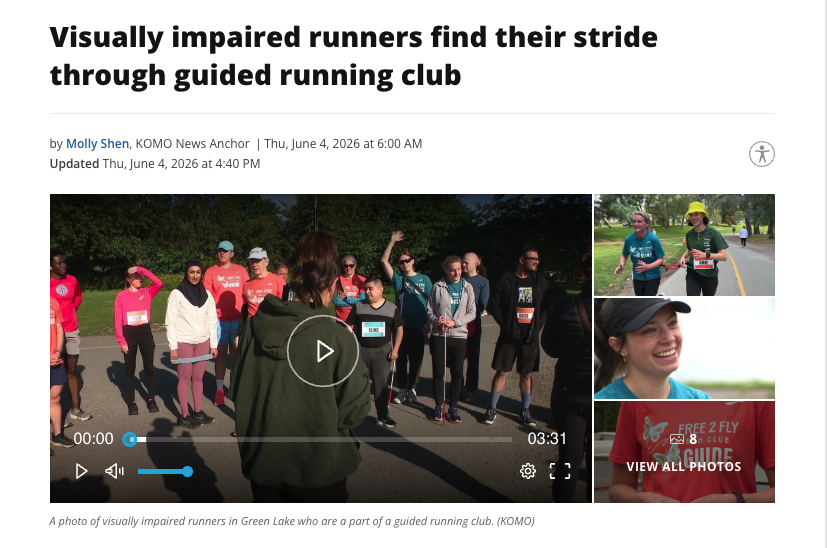
KOMO's caption (no AD provided)

A photo of visually impaired runners in Green Lake who are a part of a guided running club.

Access Hound's quick description:

Describing: A screenshot of the KOMO News website, which shows the headline of the story above a large horizontal photograph. A stack of three much-smaller horizontal photographs are to the right of the main image. All four color images are about this same "Free 2 Fly" story. 

Description: In the larger image, a woman's back is to the camera, and she faces a crowd of people, addressing them about the run they are about to do. This woman — Free 2 Fly founder Ixchel Lemus-Bromley — has her brown hair pulled into a ponytail. She is wearing a dark green hoodie and is shown from the waist up, from behind, making the crowd of runners the focal point. More than a dozen people face her and the camera. They mostly are wearing shorts or athletic leggings as well as t-shirts, with some also having light coats. They are outside with sun in their faces and grass and trees behind them. One person is raising an arm to shield the sun from her eyes. Another person is raising a hand to ask a question. 

In the three smaller images, stacked on top of each other, the top one shows two women running side-by-side, tethered at the waist to each other, on a paved path. The middle image shows a close-up portrait of Lemus-Bromley, from the shoulders up. She is wearing a baseball hat this time, with a smile on her face. The third of the three images is a muted version of a close-up photograph of a Free 2 Fly t-shirt, showing only the text on the red t-shirt and the person's arms. That image is covered by a text that reads "View All Photos" and is linked to a gallery with more images.

KOMO News.

Accessibility

KOMO News in Seattle features 'Free 2 Fly' running club, pairing blind runners with sighted guides, such as Access Hound's CEO McCullough

Access Hound actively supports making public places more accessible, including behind the scenes, wherever those opportunities might emerge and exist. We love to roll up our sleeves (or, in the case of this story, we put on a pair of shorts and running shoes) and engage with those production processes directly. CEO Stewart McCullough, for example, on most Sunday mornings can be found running around Green Lake in Seattle with the Free 2 Fly club, which is a running and walking...

Top