Loading...

Access Hound — Writings From the Field

Accessible Media is Better, More-Inclusive Media

Just say "NO" to plexiglass, especially around bronze sculptures

Audio Description
Jul 23, 2026
Avatar
Brett Oppegaard, Ph.D.
Executive Director

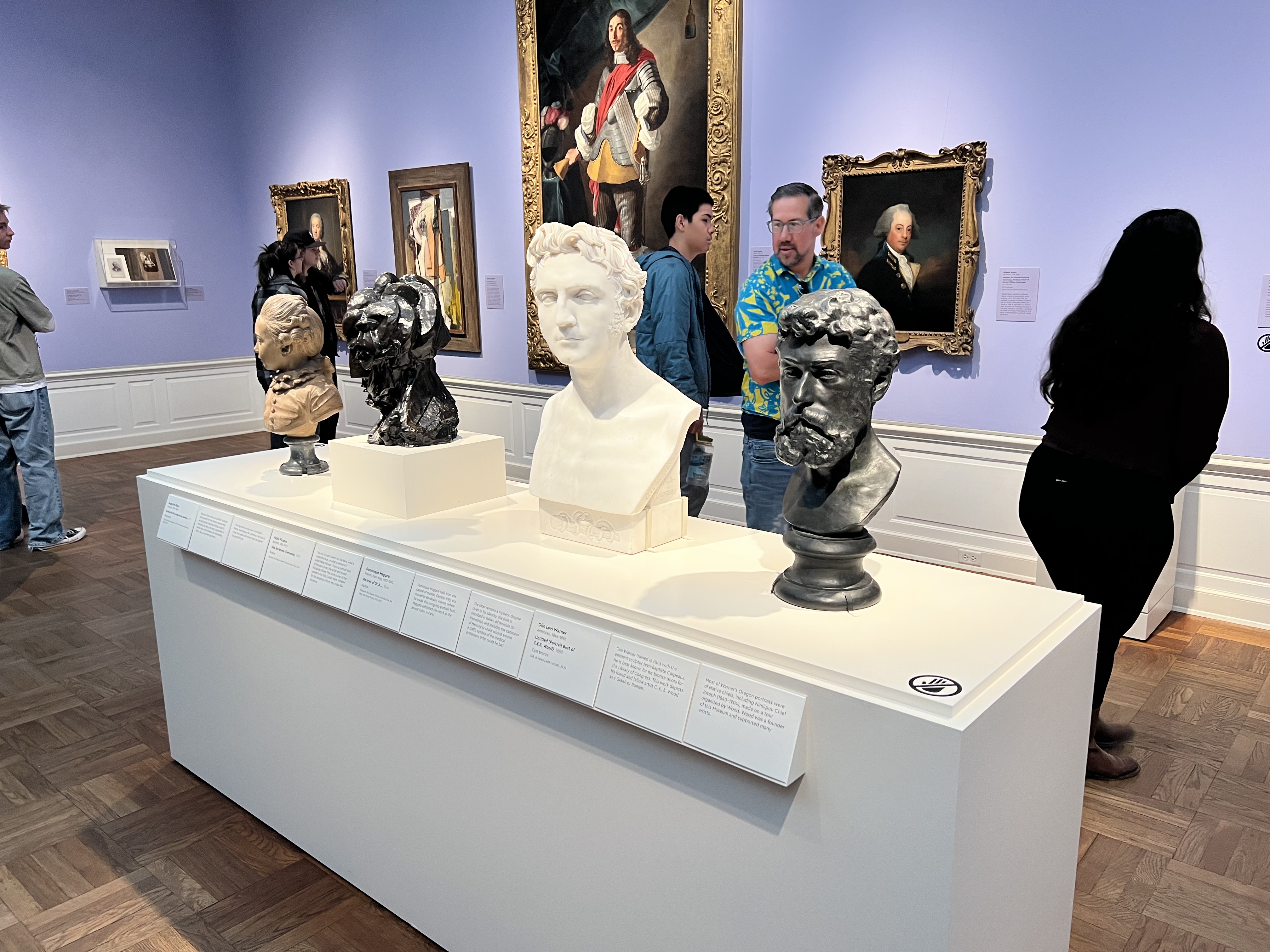
Four sculptural busts on display at the Portland Art Museum in Portland, OR, not boxed in by plexiglass. Describing: A horizontal color photograph. Synopsis: A long white display pedestal in a gallery setting is topped with four sculptural busts, showing head-and-shoulder representations of four different people in different styles with different materials, from white marble to nearly black bronze. The second one to the viewer's left is Pablo Picasso's dark bronze "Tête de femme (Fernande)," recognizable at this distance by its fractional but interconnected pieces, creating the whole of the head. The labels for the other busts cannot be read in this image from this distance. IN-DEPTH DESCRIPTION: The white pedestal crosses the frame of the photo diagonally, from about mid-frame on the left side to nearly the bottom right corner, so the bust on the far left appears smaller, and the one of the right appears larger. The front edge of the pedestal has a long rectangular strip of signage at the top, labeling and describing each piece of artwork. Near the front-right corner of the pedestal, a small round sign on the top indicates a gallery rule: No touching. On the pedestal, four busts are spaced roughly a foot apart. From the viewer's left to right, 1. A small beige bust of a person with curled hair and a high-collared, buttoned coat on a short gray stand; 2. A dark, rough-textured, modern-looking bust with angular planes and ridges (the Picasso); 3. A white, smooth bust, larger than the others, with short wavy hair and neutral expression, set on a square base; and, 4. A dark metal bust of a bearded man with a furrowed brow on a rounded plinth. Behind them, the gallery's walls are violet, and several framed paintings are displayed, including, at center, a tall, ornate, gold-framed portrait of a standing figure wearing a red sash; to its right, a smaller, gold-framed portrait of a man shown from the shoulders up, with gray hair and a military jacket; to its left, smaller works also are present, including at least one with geometric shapes rather than traditional naturalistic portraiture. A half-dozen visitors in casual clothes stand near the wall and pedestal, reading labels or chatting.

Courtesy of Brett Oppegaard

Sculptural bronzes have been produced for thousands of years and have lasted for millennia, under all sorts of harsh conditions. In other words, bronze is a material built to last. That's why I'm always so surprised to encounter bronze sculptures in museums or in galleries (or elsewhere) behind an obstructive barrier, like plexiglass. 

This mostly unnecessary protective shielding is especially detrimental to the engagement and experiences of people who cannot see or cannot see well, who would benefit greatly from permissions to get really close and to potentially even touch these sculptures. 

One possible scapegoat is the argument I have heard multiple times: If visitors are allowed to touch a bronze sculpture, they can repeatedly touch it in the same spot, over and over again, by the millions, and create a distracting and shiny part on the sculpture, like on a person's head, or nose, or belly (or in the case of the Charging Bull statue near Wall Street in New York City, um, other places). This is technically true. A touchable spot on a bronze could become shinier than other parts if touched over and over, by millions of people. A few people touching a bronze now and again, I don't think is much of a preservation threat. As evidence, consider all of the bronze sculptures around any city any where and count the shiny spots. I have only seen those in a few prominent cases and places, which attract an enormous number of people all touching the same places, usually as some kind of a social ritual. And even if so, is that really a bad thing? 

I also have heard that a plexiglass box around a sculpture keeps it from getting dusty. And if it's a small bronze, which can be carried away, then, thieves potentially could grab it. But ... doesn't someone also have to dust the plexiglass box? So what really gets gained there? And, if the bronze is small, somehow fragile, or susceptible to theft, it makes sense to shield it and tell your visitors why that is happening. 

If not, though, why not let people get closer to the artwork and maybe even touch it? That seems to me to be such a better visitor experience, and if museums are made for visitors (not as vaults for preservation), then shouldn't the visitor experience have priority whenever possible? Touching is an important sense and a way of visualizing a sculpture, especially in the case of a visitor who is blind or who has low-vision. 

In such contexts, I attended the Disability Pride event at the Portland Art Museum earlier this month, and I was delighted to encounter a bronze sculpture free of its plexiglass box in a display that actually trusted patrons enough to allow me to get my face and eyes really close to the sculptures of all different types of materials (per the photo included). 

In other places, even in this same museum, there were velvet ropes and plexiglass boxes that kept me at a distance from delicate or small objects. But when I did get this chance to get closer, I really appreciated it. 

In fact, I spent a disproportionate amount of time with these pieces, and this close access was not a trivial side note in a larger collection by some marginalized and unknown artist. 

I was able to be just inches away from Pablo Picasso's ground-breaking 1909 bronze "Tête de femme (Fernande)," the first major sculpture of his career. The ~$50 million piece, which translates roughly to "Head of a Woman," shows origins of Picasso's emerging cubist style. 

The only "protective" barrier for this monumental artwork was a small round sign, in the corner of the display counter, which had an icon of a hand underneath a symbol of a circle with a backslash, as a universal message of "don't touch." Most people, of course, don't need to be told not to touch, and I didn't ask to touch it or try to touch it. I don't know if anyone can be allowed to touch it, with protective gloves or not, but I do know that I didn't have to try to observe the artwork through a plexiglass box, and it made me wonder, why not allow people to touch it? Or, at least, how about allowing people who are blind or who have low-vision to touch it?

Am I missing something? Touching a bronze can give it a shiny spot; it will get dusty, or someone could grab it and steal it. If none of those are really critical issues with a particular bronze piece, like the Picasso sculpture, why shouldn't that type of access be spread? 

I really recommend removing these plexiglass boxes, whenever and wherever we can, not giving up on preservation or protection but just being reasonable about the risks. ... Maybe we should start a plexiglass box removal program, where we identify unnecessarily boxed bronzes and set them free?

5 min read
Share this post:
Top