Loading...

Access Hound — Writings From the Field

Accessible Media is Better, More-Inclusive Media

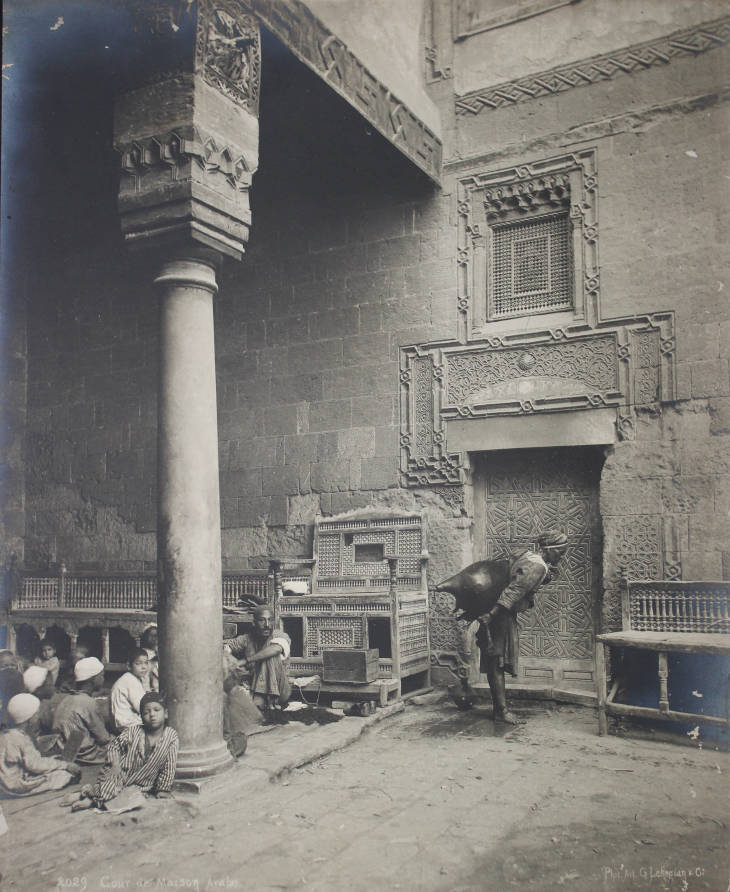
Audio Description in Action: A water carrier (Saqqa) in the courtyard of an Arab house

Audio Description
May 25, 2026
Avatar
Brett Oppegaard, Ph.D.
Executive Director

Title (English): A water carrier (Saqqa) in the courtyard of an Arab house. Title (Arabic): حاملة مياه (السقا) في فناء منزل عربي. Site (English): Saqqa Arab House Maison arabe. Site (Arabic): بيت السقا العربي. Collector: Creswell, K. A. C. (Keppel Archibald Cameron), 1879-1974. Date Created: ca. late 19th century or early 20th century.

American University in Cairo

Access Hound is working on a new Audio Description (AD) project with The American University in Cairo, describing a collection of Nubian photographs, such as this one attached, called "A water carrier (Saqqa) in the courtyard of an Arab house." For this process discussion, we'll share the description first, followed by an account of some of the complexities of making that description, including some that still are unresolved:

_______

DESCRIBING: A vertical black-and-white photograph taken in the late-19th or early-20th century in Cairo.

SYNOPSIS: In this time period, before widespread indoor plumbing in Egypt, people called saqqa would deliver water from the Nile River to houses and public fountains in the city. They were highly respected for their strength and endurance and for the critical service they provided. In this case, a dark-skinned person carrying a large round jug of sorts slung over their back is bent at the waist, leaning toward an ornate and closed doorway, as if waiting for someone to answer a knock. The doorway of this house is centered in a sunlit courtyard. A group of children is gathered nearby. They are sitting on the ground, with some looking at the water carrier and some staring instead at the photographer taking this image.  

IN-DEPTH DESCRIPTION: The barefoot water carrier wears a head cloth and loose clothing, draping at the knees, looking like a modern-day skirt. The animal-skin jug, called a qerba, is dark in color, round, like a medicine ball, and has stubby legs at its base, evoking the animal shapes of its origin. The jug's girth is bigger than the person's torso. From this distance, it's not clear if the person is a man or a woman, but saqqa traditionally were men. The doorway of the home is decorated with a pattern of geometric shapes, which each has a star-like center radiating out six symmetrical rays. To the left of the water carrier and the door is an oversized throne-like chair, next to a long bench with a high back. To the right of the water carrier and the doorway is another bench, matching the one on the other side. The doorway is a part of a much larger and highly decorative stone wall that is showing signs of deterioration and aging. Some of its decorative features have peeled off, and the furniture appears covered with dust. Eight children are in the frame of the photograph, with an adult at the front of the group, also seated on the ground but facing the kids, who are mostly facing toward the doorway. They are all seated around a massive stone pillar in the room. It is the only pillar in the image. Half of the children are wearing head coverings. Above this doorway, a small window is encased with metal lattice and surrounded by ornate stonework. The courtyard floor appears cracked and uneven, contributing to the sense of age and enduring use. Light enters the scene from above, illuminating the center of the courtyard while leaving the edges in softer shadow, emphasizing the contrast between the seated children and the water carrier. 

_______

This image — and all of the images in this collection — raise many complex and important issues about Audio Description as an art and as a craft. Discussions about such issues are valuable for both museum professionals, who want to make more accessible materials, like this, available to more people, and Audio Description experts, who want to make better descriptions. The ultimate aim for everyone is inclusivity, using descriptions to invite more diverse and broader audiences to participate in public discourse, regardless of whether the person is hearing the image or seeing it. We want to support and contribute to such discussions. 

We therefore are starting an "Audio Description in Action" feature on our Access Hound website, using this image, to periodically share such complicated cases that we are describing for clients, as a way to raise topics for discussion about those images, and to discuss the ways in which we approach these particularly difficult describing processes. 

In this case, but in any case, we at first wanted to know as much about the photo as possible. Where was it taken? Who took it? Why? When? What are the people doing there? 

Visual media often originates as a part of a larger story being told; when an image gets disassociated from that context and narrative, describing what is happening in the modular image gets much more difficult and sometimes nearly impossible. AD ideally, of course, should be done as a part of the production workflow, at the moment of its creation, in order to keep all critical details connected. 

Photographers take an image, process an image, produce the final version, and share it with an audience. During that time, the photographer also usually provides a caption, explaining the foundational parts of the picture to contextualize it, and takes a credit line, too, to ensure getting credit for taking the photo.

Audio Description (AD) is just one more step in that production process. When done at the same time as the caption, AD is not that much more work to add. It also is as easy to do as it ever will be, in that moment, because the information about the image already is readily available, and describing the image is just another opportunity, like with the caption, for the photographer to contextualize and explain the image, its visual meaning, and its significance. 

A few days later, though, or, in this case, more than a century later, and so many pieces of foundational information about the photo will have been lost to time. Describing such a historic image thereby presents a major challenge, and some of the key details, like the names of the people in this image, and what they were all doing there in that moment, will never be recovered or adequately explained. All of the children in that photo have lived their lives and died, leaving no witnesses. That means if you do not add AD now, your image in the future will be described in different ways by different people (and different automated processes), without the quality controls that you can provide in the moment of production. So add the AD now, whenever you make and publish an image, as a way to make it inclusive and accessible to all, building your audiences, and also as a way to ensure the image and its description have wholeness for time immemorial. In other words, fix that workflow before it is too late. 

The first really important steps for us to take to understand this image, before describing it, were to establish and to reconnect as much as possible its physical, cultural, social, and historical contexts. The museum's existing metadata provided some information, most of which also is shared here, referencing the image as showing a house in Cairo and involving a water carrier. Without those clues, it would have been difficult to know what we were looking at and where to begin. With all of these other mysteries in the image, we were able to develop the description by following clue after clue, until we reached points, like with the water carrier's gender, that we could have made a highly probable guess that the person was male, but we didn't know that for sure, so we generally do not guess, preferring ambiguity and factual accuracy to misleading or inaccurate descriptions. In short, we do our best with what we have and what we can gather.

5 min read
Share this post:
Top